Shopify vs WooCommerce — Choosing the Right Ecommerce Platform
Shopify vs WooCommerce is the first real decision in an ecommerce project, and it gets argued about like a religion. It isn't one. They're two different deals, and the right answer depends far less on features than on what you want to be responsible for. Most owners who start looking into Shopify website design have already half-decided anyway — usually because a friend runs a Shopify store, or because someone told them WooCommerce is free.
Both are shaky reasons to spend a year of your business on a platform. So here's the honest version: what each one actually is, what each really costs once the whole bill is assembled, where each genuinely wins, and how to pick. It's the ecommerce case of the same trade-off we walked through in WordPress vs custom-coded — convenience on one side, control on the other.
The Real Difference Is Renting vs Owning
Strip away the feature tables and the distinction is simple.
Shopify is a product you rent. You pay a monthly fee and Shopify runs the whole machine — servers, security patches, PCI compliance, the checkout, uptime. You get an admin panel and a theme you can style. You don't get the underlying platform, and you can't take it with you.
WooCommerce is a free plugin you install on your own WordPress site. Nobody is running anything for you. You buy the hosting, you install it, you choose the plugins, and you own every file. Nothing stops you moving the whole store to a different host tomorrow.
That's the entire thing. Every other difference below falls out of that one.

What Each One Actually Costs
This is where most comparisons go wrong, because they hold a monthly fee up against the word "free."
Shopify: predictable, with one catch
Shopify's entry plan runs $39 a month, or $29 if you pay annually. That covers hosting, SSL, security and support — genuinely all of it, with no surprise infrastructure bill in month four. Card processing is separate, at roughly 2.9% + 30¢ on a standard online sale.
The catch is the line nobody reads. Per Shopify's own pricing page, "third-party transaction fees may apply when you use a third-party payment provider (instead of Shopify Payments)" — 2% on the entry plan, shrinking as you move up the tiers. That's a fee charged on top of whatever your processor already takes, purely for not using theirs. If you're attached to an existing merchant account, price that in before you commit rather than after.
WooCommerce: free the way a puppy is free
The plugin costs nothing. The store does not. You'll pay for hosting that can actually carry a checkout — budget shared hosting folds under one — plus a domain, a decent theme, and then the plugins for whatever your business does beyond simple products: subscriptions, bookings, real shipping rules, better search. Most are annual licences, not one-time buys.
Then there's the part nobody budgets. Somebody has to keep WordPress, WooCommerce and every plugin current, on a site that handles card data. That's either your evenings or someone's invoice. Run honestly, a small WooCommerce store often lands in the same monthly range as Shopify — the difference is that Shopify's number arrives on one invoice, and WooCommerce's is spread across five of them plus your time. It's the same pattern we broke down in how much a website costs.

Where Shopify Genuinely Wins
Speed to live. A competent Shopify store can be selling in weeks. There's no server to configure and no stack to assemble before you start.
Someone else owns the emergency. When payments break at 2am on the busiest Saturday of the year, it's Shopify's problem and Shopify's engineers. For a business with no developer, that's worth real money — you're buying a category of problem out of your life.
The checkout. Shopify has tuned one checkout across an enormous number of stores. Matching that on a self-hosted build is possible, and it's work you'd have to pay for.
Maintenance is nobody's job. No update queue, no plugin conflicts, no PCI paperwork. If your competitive advantage is your product rather than your website, that's exactly where you want the burden to sit.
If you sell physical products, you aren't technical, and you want to be trading soon — Shopify is usually the right answer and the argument can stop there.
Where WooCommerce Genuinely Wins
You already have a WordPress site that works. If you've got traffic, a blog and rankings on WordPress already, bolting on a store keeps everything in one system instead of splitting your brand across two.
Content-led selling. When your customers find you by searching questions rather than product names, having the content and the store in one place is a genuine structural advantage.
No platform tax. Take payments however you like. Nobody charges you a percentage for choosing your own processor.
Anything unusual. Odd pricing rules, B2B logic, custom product fields, an integration with some niche piece of software your industry runs on — WooCommerce will bend to it. Hosted platforms often won't.
You own it. No one can change your terms, raise your rate, or decide your store is no longer welcome. For some owners that alone settles it.
The flip side is that a WooCommerce store is exactly as fast as you make it. Shopify's floor is higher; WooCommerce's ceiling is higher. If you go this route, website speed becomes your responsibility rather than a feature you're renting.

The SEO Question Is Mostly a Non-Issue
Both platforms rank perfectly well. Whichever one you're on is almost certainly not what's holding your store back.
What actually decides it: collection pages carrying real copy instead of bare product grids, product pages that answer what a buyer wants to know before spending, and sound technical basics. That last one bites ecommerce harder than any other kind of site, because filters and sort orders spawn near-endless URL variants of the same products — the duplicate-URL problem from our guide to technical SEO, in its most aggressive form.
Shopify handles a lot of that by default but locks you into a fixed URL structure. WooCommerce gives you total control, including the freedom to build something Google struggles with. Neither is a reason to choose a platform. The SEO work that moves an ecommerce store is the same work on both, and our guide to ecommerce SEO walks through it in priority order.
What This Looked Like on a Real Store
GMA Warrior Supplements came to us on Shopify already — running a generic template with clashing colors that shared nothing with the martial arts brand behind it, and collection pages that were bare product grids with nothing for Google to read. We rebuilt it on Shopify rather than moving it, because the platform was never the problem.
The rebuild put 8+ collection pages and 25+ product pages in place, each built around what buyers actually search, and mobile performance went from 65 to 95 with a 100/100 on Lighthouse's SEO audit.
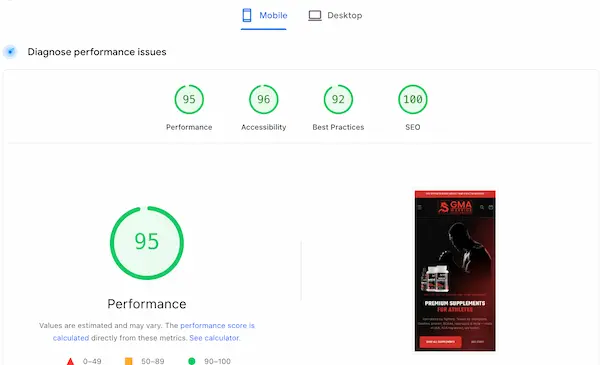
The honest note, because it's the useful part: those are readiness scores, not revenue. What made the rebuild work was pairing the technical lift with collection pages that answer category-level questions and a content engine aimed at what buyers ask before they spend. Switching platforms would have changed none of that. The platform was never the variable — what got built on it was.
How to Actually Choose
Pick Shopify if: you're selling physical products and want to be live in weeks; nobody on your team wants to own updates and security; you're happy using Shopify Payments; and your catalog is normal — products, variants, collections.
Pick WooCommerce if: you already run a WordPress site with real traffic; content is your main acquisition channel; your products need logic a hosted platform won't bend to; you have a developer or a budget for one; or ownership matters to you on principle.
And if you're genuinely torn, that's information too — it usually means either would work. Take Shopify, because the cost of being wrong is lower and the exit is a rebuild either way.
What doesn't change with the platform is that a store only makes money if the pages convert once people arrive. That's the same checklist as what a website needs to convert, and it's where the return actually lives. If you want to see how we've handled builds on both sides of this, the work we've done is an honest sample.
Frequently Asked Questions
Not sure which platform your store should be on?
Book a free 30-minute call. We'll look at what you sell, how customers find you, and who's going to maintain the thing — then tell you straight which platform fits and what it'd actually cost. No pitch deck, just a real conversation.
Book a Free Ecommerce Call