Cannabis Marketing Without Paid Ads — The Playbook That Actually Works
Cannabis marketing starts from a strange place: the two channels every other business leans on are closed to you. You can't buy Google Ads. You can't run Meta ads. The playbook every marketing blog writes — "set a budget, launch a campaign, scale what works" — doesn't apply. That's the constraint every operator we talk to has already hit, and it's why marketing for cannabis brands and dispensaries looks so different from marketing anything else.
Here's the part nobody tells you: the constraint is an advantage. In a normal industry, the competitor with the deepest pockets buys the top of the page. In yours, they can't. Everyone is fighting on the same ground — search, content, and the customer list you own — and that ground rewards whoever builds first and stays consistent. If you want the mechanics of the biggest lever, start with how local SEO works. The rest of this is the cannabis-specific version.
Why the Ad Platforms Are Closed
It's not a gray area and it's not a targeting setting you haven't found. Google's Dangerous Products or Services policy prohibits ads for substances that induce a high, and Meta's advertising standards say effectively the same thing. The one narrow carve-out is topical, hemp-derived CBD at 0.3% THC or less, in a short list of states, with certification. If you sell THC, you're outside it.
Two things follow. First, don't waste money on an agency that promises to get you running on Meta anyway — the usual outcome is a banned account and a lost pixel history, not a clever workaround. Second, budget the money you would have spent on ads into the channels that compound instead. That's not a consolation prize. It's a better allocation.
The Five Channels That Actually Work
1. Local search — the one to build first
Somebody three blocks away is searching "dispensary near me" at 7pm on a Friday. Whether they walk into your shop or the one down the street is decided in the map pack, and that result costs nothing to win. A complete and actively maintained Google Business Profile — real hours, current photos, menu link, steady review flow — plus dedicated pages for each city you serve is the single highest-return work in cannabis. Our SEO work for cannabis operators almost always starts here, because it's the fastest path from "invisible" to "found."
Then go wider than "near me." Cannabis buyers search by brand, by product category, and by effect, and each of those is a page you can own. Build a page per brand you carry and per city you deliver to. If you've never done this systematically, keyword research is the starting point — it tells you which of those pages are worth building first. The full version of this job, including the embedded-menu problem that hides most product catalogs from Google, is in our guide to dispensary SEO.
2. Content that answers the questions budtenders get all day
Every question a customer asks at the counter is a search someone else is typing. What's the difference between live resin and rosin. How long do edibles take. What's a reasonable first dose. Answering those honestly on your own site does three jobs at once: it ranks, it builds the kind of trust that gets someone to order from you instead of a marketplace, and it gives your email and social something to point at.
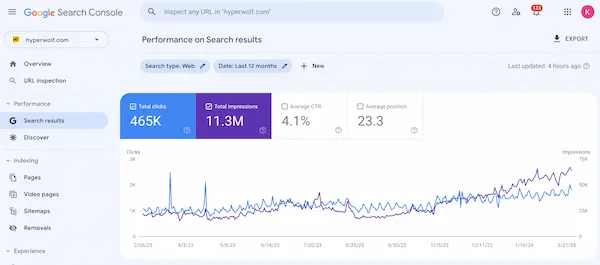
This is where the compounding shows up. We ran full-stack growth for Hyperwolf, a Southern California cannabis delivery brand, and the organic side of that engagement is the clearest proof we have: monthly organic clicks went from about 1.4K to 12K, impressions from 28K to 340K, and the site ended up with 100+ first-page keywords — built on technical SEO, a content engine, and dedicated brand and city pages. They ran compliant programmatic ads too, through Surfside. But the organic traffic is the part that kept paying after the spend stopped.
3. Email and SMS — the money channel
Once someone has bought from you, reaching them again costs almost nothing. Drop alerts, restock notifications, loyalty tiers, win-back messages for the customer who hasn't ordered in six weeks — this is the channel that drives repeat revenue in cannabis, and it's the one most operators under-build. On Hyperwolf's owned channels we saw SMS click rate move from 12% to 38% and revenue per recipient go from $1.20 to $8.40.
The compliance wrinkle is real: mainstream email and SMS platforms have their own rules about cannabis, and the practical answer is usually a split stack — a cannabis-native platform like AlpineIQ for SMS and loyalty, plus a mainstream ecommerce platform for newsletters and automated flows. Whichever tools you land on, the flows themselves are the same ones any business needs. Our guide to email marketing covers the five that make money, and the email and CRM automation layer is what makes them fire without anyone remembering to send.

4. Organic social — brand, not acquisition
Instagram will not let you sell cannabis, and it will deplatform accounts that try. Treat it as a brand channel instead: product drops, culture, events, collabs, the people behind the counter. Done well it builds recognition that makes your other channels convert better — someone who's seen your brand for months clicks a search result differently than someone who hasn't.
The most durable version of this isn't content you make. It's content your customers make. User-generated content reads as real in a category where polished brand posts often don't, and it sidesteps the awkwardness of a licensed business posting product shots. Keep a second account as insurance, keep your list off-platform, and treat every follower as someone to move onto email. Our social media and content work in this industry is built around exactly that assumption: the account can disappear, the list can't.

5. The website — where all four of the above cash out
Every channel above sends traffic somewhere. If that somewhere is a slow template with a menu that doesn't match what's actually in stock, you're paying for the traffic in effort and losing it at the door. The essentials are unglamorous: fast on a phone, menu synced to your POS so prices and inventory are right, age gate that doesn't feel like a wall, and a checkout that remembers a returning customer. Everything in our guide to a website that actually converts applies here, plus the cannabis-specific integrations — Dutchie, Jane, Treez, Meadow — that make the menu trustworthy. That's the bulk of what cannabis web design is actually about.
What About Weedmaps, Leafly, and Compliant Programmatic?
There are real paid options in cannabis — they're just not Google and Meta. Weedmaps and Leafly sell placement to people already shopping. Cannabis-compliant programmatic platforms like Surfside run display and connected-TV inventory against age-verified audiences. Both work, and both belong in the plan once the basics are running.
Know what you're buying, though. On a listing platform you're renting the customer relationship: they own the traffic, control the ranking, set the price, and show a competitor's menu right beside yours. That's a fine trade while you're building — it's a bad place to still be in year three. Use them for discovery, measure what a listing customer costs against an organic or email one, and shift the mix as your own channels mature. The same discipline we bring to paid ads in other industries applies: if you can't measure what it returns, you're not running a channel, you're paying rent.
The Order to Build It In
Doing all five at once is how operators end up doing none of them well. The sequence that works:
- Fix the site and the menu sync first. Everything downstream converts through it, so a leaky site makes every other channel look worse than it is.
- Claim and complete local search. Google Business Profile, reviews, city pages. Fastest return of anything on this list.
- Turn on email and SMS. You likely already have a customer list sitting in your POS doing nothing. It starts paying within the first month.
- Then build the content engine. The slowest to pay off and the hardest to copy — most operators start seeing real organic movement around 90 to 120 days.
- Layer paid on top, last. Listings and compliant programmatic amplify a system that works. They don't fix one that doesn't.
None of this is exotic. It's the same marketing fundamentals every business runs, minus the shortcut of buying attention — which mostly means the operators who commit actually get to keep their lead. If you want to see how we approach builds across industries, the work we've done is the honest sample.
Frequently Asked Questions
Want to know which channel to fix first?
Book a free 30-minute call. We'll look at your site, your local search, and your customer list, and tell you the one thing worth fixing first — no pitch deck, just a real conversation.
Book a Free Cannabis Strategy Call