
Dispensary SEO — How Dispensaries Get Found on Google
A dispensary can't buy its way to the top of Google. The ad platforms every other local retailer leans on are closed to plant-touching businesses, which makes dispensary SEO less a line item and more the whole acquisition channel. That's the structural difference that shapes everything about marketing a dispensary versus marketing anything else on the same street.
We've covered the wider channel mix in our cannabis marketing playbook. This one goes narrow — how a store actually gets found in search, which parts of the job differ from ordinary local SEO, and the one technical mistake that quietly hides most dispensary product catalogs from Google entirely.
Two Searches, Two Completely Different Jobs
Almost every dispensary search falls into one of two buckets, and they need different work:
- "Dispensary near me." "Weed delivery in [city]." "Dispensary open now." Someone has already decided to buy. The question is only where. This gets answered in the map pack, usually on a phone, usually in under thirty seconds.
- Product and research searches. Strain names, effects, edibles versus vapes, what a terpene actually does, how much to take the first time. These catch people earlier, and they're where almost all the volume lives.
Most stores chase neither one properly. They have a profile nobody maintains and a website that's a homepage plus a menu. The whole discipline of SEO for a dispensary comes down to owning the first bucket completely, because it converts, and then building enough of the second to keep the pipeline from depending on people who already know your name.
The Map Pack Is Where the Near-Me Search Ends
For a "near me" search, the three map results at the top absorb most of the clicks. Ranking there isn't a website job. It's a profile job, and it's the fastest-moving lever a dispensary has.
The unglamorous fields are what move it: your primary category set correctly, hours that are actually right on holidays, a service area that matches reality, real photos of the storefront and the parking situation, and answered questions in the Q&A section before somebody else answers them for you. Our walkthrough of Google Business Profile optimization covers the full field-by-field pass.
One caveat specific to this industry: some of the retail add-ons other businesses lean on — product listings, order buttons, certain promotional post types — are limited or unavailable for regulated products. Check what's actually available on your profile rather than assuming, and don't build the plan around a feature you can't use.

Your Menu Is Probably Invisible to Google
This is the one that costs the most and gets noticed the least.
Most dispensary websites embed their menu from a third-party platform inside an iframe. It looks like part of your site. It isn't. An iframe is a separate page loaded inside yours, served from your provider's domain — and content inside that frame is credited to the domain serving it, not the page framing it.
Think about what that means. Your product catalog is the richest, most keyword-dense, most frequently updated content you own. Every strain, every brand, every category, every product description. And in the standard setup, none of it earns your domain a thing. You're running a website whose single most valuable page is functionally blank to a search engine.
The fix isn't complicated, but it is a build decision: get the menu rendering on your own domain rather than in a frame. Most menu platforms now offer a native or on-domain option, and the ones that don't are worth leaving. Failing that, build indexable category pages on your own site — a real page for each product category and each brand you carry, with actual copy on it — and let the frame handle the transaction only. That's a web design question as much as a search one, which is exactly why the two shouldn't be bought from separate vendors.

One Real Page Per Store
If you run more than one location, each one needs its own page, and it needs to be a real page — not the same three paragraphs with the city name swapped. That version fools nobody and reads as thin to both a customer and a crawler.
A location page that earns its keep carries the address, the hours, the parking and ID situation, the delivery zones it actually serves, the staff, and something specific about that store that isn't true of the others. Mark it up with local business structured data — name, address, phone, geo coordinates, opening hours — so Google can read the details without guessing. Google's own guidance is blunt about it: the more properties you provide, the higher quality the result is to users.
The same rule applies to the terms you target. A store in one city shouldn't be fighting its own sibling store for the same phrases. Sort that out at the keyword research stage rather than discovering it six months in when two of your pages are quietly cannibalizing each other.
Reviews Do Double Duty
Reviews are a prominence signal for local ranking and the single biggest conversion lever on the map pack at the same time. Two stores rank next to each other; the one with 400 reviews at 4.7 gets the click over the one with 60 at 4.4, more or less every time.
What matters is the flow, not a one-off push. A steady trickle of recent reviews reads better than 200 from two years ago, and the ask works best where the transaction actually ends — at the counter, from a budtender, in the moment somebody's happy. Automate the follow-up, respond to every review including the bad ones, and treat a specific complaint as free product feedback rather than a PR problem.

The Directories Are a Second Search Engine
Weedmaps and Leafly aren't links to chase — most directory listings pass nothing, and treating them as a link-building play is a waste of a good channel. What they actually are is a second search surface where high-intent shoppers browse before they drive anywhere, plus a consistency check.
Keep your name, address and phone identical everywhere they appear — the directories, the profile, your own site's footer. Mismatched details across listings are one of the more common and more boring reasons a store underperforms in local search. Fix them once, then keep them fixed when the suite number or phone system changes.
What Focused Budget Actually Produces
Numbers help here, so here's a real portfolio rather than a hypothetical. Gold Flora is one of California's largest vertically integrated operators — 7 retail brands across 17 stores. SEO didn't get a budget per location; it got one shared pot across six tracked stores. We made the call early to concentrate spend on two flagships and one newer store with room to grow, and maintain the rest.
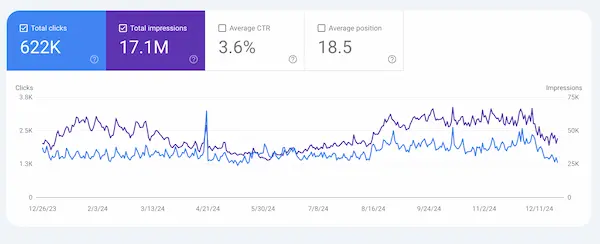
Across the portfolio that produced 1.48M+ annual organic clicks and 43.7M+ annual impressions. At the flagship, Airfield Supply Co., annual clicks went from 180K to 622K, impressions from 5M to 17.1M, and average position from 34 to 18.5 — which is the difference between page four and the bottom of page two, and it's where the click curve starts to bite. The newer store went from 7K to 43.4K annual clicks on a fraction of the spend.
Two honest caveats. That portfolio also ran compliant paid channels alongside the organic work, so this isn't a claim that SEO did it alone. And the concentration decision is the transferable part, not the numbers — spreading one budget evenly across six stores would have produced six stores that moved slightly. Pick the locations with the most upside and actually fund them.
Where to Start
In order, because the order matters more than the effort:
- Fix the profile first. Categories, hours, photos, Q&A, and a review flow that runs every week. Cheapest work, fastest movement.
- Find out whether Google can see your menu. Search a product name from your catalog with your domain and see if anything comes back. If nothing does, you've found your biggest project.
- Build one real page per store. Then the category and brand pages under them.
- Clean up the listings. One afternoon, permanent benefit.
- Then write. Product and education content, aimed at the questions your budtenders answer twenty times a day.
Track it properly while you do — organic clicks and map-pack actions by location, not sitewide totals that hide which store is actually working. That's a marketing analytics setup, and without it you'll be guessing about which of the five steps above paid for itself.
Worth saying plainly: advertising and marketing rules for cannabis vary by state and change often, so check your own regulator before publishing anything promotional. None of this is legal advice. If you'd rather hand the whole thing over, the work we've done is an honest sample of how we run it.
Frequently Asked Questions
Want to know why your store isn't ranking?
Book a free 30-minute call. We'll look at your profile, check whether Google can actually read your menu, and tell you which of the five steps above would move the needle first — no pitch deck, just a real conversation.
Book a Free SEO Call