Keyword Research for Beginners — Find the Words Your Customers Actually Search
Here's the uncomfortable truth behind most small-business websites: they're built around the words the owner uses, not the words customers type into Google. You might call yourself a "wellness studio." Your customers are searching "massage near me." Keyword research is how you close that gap — the process of finding the exact phrases real people search for, so your site shows up when they're ready to buy.
Get it right and everything downstream gets easier. Your pages match what people actually want, your content earns traffic instead of collecting dust, and your ad budget stops paying for clicks that go nowhere. It's the first move in almost every project our SEO services take on, so let's break down how to do it — even if you've never opened an SEO tool in your life.
What Keyword Research Actually Is
A keyword is just a word or phrase someone types into a search engine. "Plumber," "emergency plumber Riverside," "why is my water pressure low" — all keywords. Keyword research is the work of finding the ones your customers use, then deciding which are worth targeting. It's less about Google and more about listening to how your market talks.
The payoff is intent. Someone searching "how much does a website cost" is in a very different headspace than someone searching "best taco spot." Keyword research lets you find the searches that signal someone is close to becoming a customer — and build pages that meet them there. It pairs naturally with SEO for small business, which covers what to do once you know your keywords.
The 3 Things Every Keyword Tells You
When you size up a keyword, you're really weighing three signals against each other:
- Search volume — roughly how many people search it each month. Bigger isn't always better; a huge term is usually a crowded, hard-to-win one.
- Difficulty — how hard it'll be to rank against everyone else already targeting it. New sites win small before they win big.
- Intent — what the searcher actually wants. Are they buying, comparing, or just learning? Match your page to that, or you'll rank and still get no business.
The sweet spot for most small businesses is the long-tail keyword — a longer, more specific phrase like "mobile dog grooming in Orange County." Lower volume, but far less competition and much higher intent. Ten of those can out-earn one impossible-to-rank head term.

How to Do Keyword Research — Step by Step
1. Start with a brain-dump
Before any tool, list every service you offer and every way a customer might describe it. Think like them, not like an insider. "Teeth whitening," "yellow teeth fix," "cosmetic dentist near me" — all valid seeds.
2. Let Google expand your list
Type a seed into Google and watch the autocomplete suggestions — those are real searches, ranked by popularity. Scroll to the "People Also Ask" box and the "Related searches" at the bottom of the page. Free, instant, and straight from the source.
3. Pull real numbers
Drop your list into Google Keyword Planner (free with a Google Ads account) to see volume and competition. Tools like Ahrefs and Semrush go deeper, but you don't need them to start. The goal is to separate the phrases people actually search from the ones only you say.
4. Sort by intent
Group your keywords: buyer terms ("book a", "near me", "cost", "hire"), research terms ("how to", "best", "vs"), and brand terms (your name). Buyer terms get your service pages. Research terms get blog posts — exactly like the one you're reading, and increasingly drafted faster with AI content creation tools.
5. Map one keyword to one page
Each important keyword gets its own focused page, with that phrase in the title, the headline, the URL, and the first paragraph. Don't cram five services onto one page and hope — give each its own home. This same research also feeds your Google Ads, where the right keywords decide whether you pay for buyers or for tire-kickers.
Don't Forget Local and "Near Me" Keywords
If you serve a specific area, your most valuable keywords almost always carry location intent — "near me," a city name, or a neighborhood. These convert like crazy because the searcher is nearby and ready. Weaving your city and service area into the right pages is the heart of how local SEO works, and it's often where a small business sees the fastest wins.
Turning Keywords Into Actual Traffic
Research only matters if it ships. Take Hyperwolf, a cannabis delivery brand we work with. We mapped the searches their customers were actually making — city-by-city delivery terms, product searches, "near me" queries — and built pages and content around them. Over a year, their organic search traffic climbed steadily as those keyword-targeted pages started ranking:
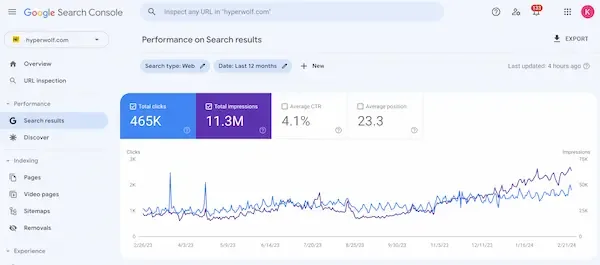
That's the whole point of keyword research: it turns guesswork into a map. You stop publishing pages and hoping, and start building exactly what your market is already searching for. Browse the rest of our work and you'll see the same pattern under almost every result.
Frequently Asked Questions
Not sure which keywords are worth chasing?
We'll dig into what your customers are actually searching, find the keywords you can realistically win, and show you the pages to build. Free, no commitment.
Book a Free Keyword & SEO Audit